
Personalisation
How Jeevrit personalises your day across food, training and your cycle
What changes when your food, your workouts and your cycle work together with Jeevrit+, in plain words, and what you always stay in control of.
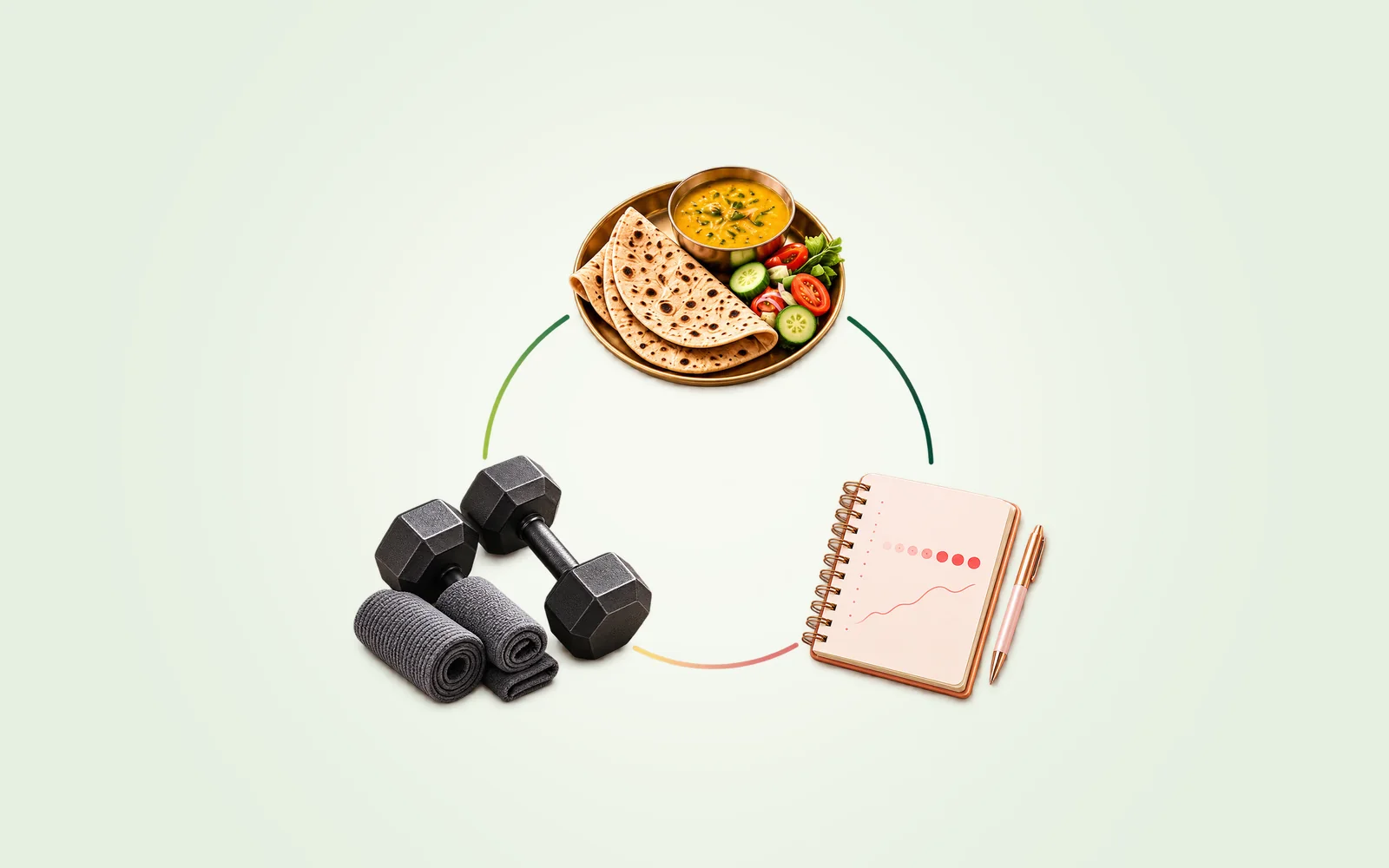
A plan written for an average person fits nobody’s real week. How much you trained, how you slept and where you are in your month all change what a sensible day looks like. That is why Jeevrit is three spaces in one app: Jeevrit for food and daily habits, Stride for training, and Laya for your cycle. With Jeevrit+, they talk to each other, so each one knows a little about the rest of your day and can help you more. Here is exactly what that means, in plain words.
At a glance
- Train in Stride, and your food targets keep up with your workouts.
- Track your cycle in Laya, and, if you allow it, your daily plan and your workouts fit your month.
- Sleep badly, and Stride can offer an easier session.
- Ask Jivi, and it already knows the context you have allowed, so you explain less.
Three spaces, one account
Each space works on its own. You can log meals without ever opening Stride, or track your cycle without a training plan. Your name, goals and permissions live in one account, so you set things up once. What Jeevrit+ adds is the links between the spaces: something you do in one helping the others.
Your training, counted in your food targets
Training changes how much energy and protein your body needs. Targets that ignore your workouts are written for a week you are not living.
Switch on “Track my workouts”, and the Stride sessions you finish count towards your weekly calorie and protein targets. Jeevrit looks at your training over the past month, so your targets follow your real routine instead of jumping after one big session.
- Your daily target stays steady on gym days and rest days. Workouts raise your weekly average, so a rest day never feels like a day to make up for.
- Your targets catch up the next day, not the same evening.
- Workouts from your watch count too, on any plan, when they come in through Health Connect, Android’s health hub.
- You see it everywhere: finished sessions appear in your weekly report and count towards your streak.
Your cycle, in your daily plan
Some needs follow a monthly rhythm. A period takes iron with it, and it takes weeks to build back up. In the days before a period, many people sleep a little warmer and feel hungrier. A plan that knows roughly where you are in your month can offer the right small idea at the right time.
If you let Laya inform the rest of Jeevrit, your daily plan can include a few cycle-aware ideas. Each one names a change in your body and something practical to do about it:
- During a period: “Something sour on the dal this week”, because a squeeze of nimbu helps your body take in the iron from dal, palak and rajma; “Chai an hour after lunch, not with it”, because tea with a meal blocks some of its iron; and “Same walk, slower — not no walk”, because the usual effort can feel harder.
- In the days after: “The period’s over — the iron it took isn’t back yet”, with familiar iron-rich foods like rajma, chana, masoor and bajra roti.
- Before a period: “The room a bit cooler than usual tonight” and “Hungrier this fortnight is real — put protein in front of it”.
These ideas never comment on your mood, and they never tell you to stop moving. If Laya can’t tell reliably where you are in your cycle, they simply don’t appear. The Laya guide to your cycle and the rest of your day explains what is shared and what stays private.
Your sleep, in your training
Before each workout, Stride gives you a simple readiness check: high, moderate or low. It looks at how last night’s sleep compares with your normal, whether today’s muscles still need rest from yesterday, and whether your last session felt too hard. If you connect your cycle, the first days of a period, or a day you logged cramps, pain or low energy in Laya, are taken into account too. On a low day, Stride offers to make the session one set lighter on each exercise. The Stride guide to training around your sleep and your cycle covers it in detail.
Jivi, with the context you allow
Jivi, the AI guide in Jeevrit, gives better everyday ideas when it knows what your week looks like. With Jeevrit+ and your permission, Jivi can use your food logs and recent Stride workouts and, if you allow it, your cycle day and when your next period is due. You spend less time explaining, and its ideas fit the day you are actually having.
You stay in control
- Anything that leaves Laya, and anything Jivi uses, needs its own permission. Sharing your cycle is separate from tracking it, and you can take it back at any time. When you do, the rest of Jeevrit keeps no copy.
- Buying Jeevrit+ does not change any of your sharing choices.
- Nothing changes behind your back. Stride offers a lighter day; you decide.
- Changing your plan never deletes anything you logged.
Safety comes first, on every plan
Some information makes a plan safer rather than more personal, and that always flows between the spaces, free or paid. The health conditions, medicines and age you have told Jeevrit shape what Stride suggests. If you tell Laya you are pregnant or have recently given birth, Jeevrit will not ask you to eat less than you need, and Stride checks every exercise before it suggests it. These protections are never part of a subscription.
When to get personal advice
Connected suggestions are everyday guidance for healthy adults. If you have a medical condition, are pregnant, or have been given a specific diet or exercise plan, a doctor or registered dietitian can tailor it to you.
Sources
This article shares general wellbeing information. It is not medical advice and does not replace a doctor or registered dietitian who knows your health history.
All Jeevrit articlesA little better starts with today.
Log familiar meals in household portions, follow a small daily plan and see your week come together.
Get JeevritFree on Google Play for Android.More from the Jeevrit journal
 Getting started · 6 min readGetting the most out of JeevritSet it up, log the way you eat, and see what Jeevrit+ adds.Read article
 Food · 4 min readA balanced lunch with familiar foodA practical plate, built from the foods you already know.Read article
 Sleep · 3 min readAn easier evening wind-downSmall, realistic ways to signal the end of your day.Read article
 Everyday habits · 2 min readSmall habits for busy daysRoutines that have a place in the day you actually have.Read article