
Recovery
Training around your sleep and your cycle
Why a short night, sore muscles or the first days of a period can change how a session feels, and how Stride’s readiness check suggests a lighter day.
Some days the same session feels easy. Other days the warm-up feels like work. Usually there is a reason you can point to: a short night, legs still sore from yesterday, the first day of a period. Training well is partly about noticing those days and adjusting a little, instead of either pushing through everything or skipping.
What a short night does to a session
Much of your recovery happens while you sleep. Researchers who looked across many studies of sleep and exercise found that short, all-out efforts often hold up after a poor night, while longer efforts and skilled movements tend to suffer, and that the effect is different for everyone.
In practice, one short night is not a reason to skip. It is a good reason to keep your weights where they were rather than chase a new best, and to stop a set early if your form starts to slip.
Why muscles you worked yesterday matter
Muscles adapt in the time between sessions. Training the same muscles hard again within a day leaves little of that time, which is why most plans alternate muscle groups or leave a rest day between hard sessions.
Your period and training: what the research says
You may have seen advice to train differently in every week of your cycle. The research is more modest than that. A large 2020 review that brought together 78 studies found that performance may dip very slightly during a period, but the difference was tiny and varied a lot from person to person. The researchers’ conclusion: there are no one-size-fits-all rules, and how you respond is the better guide.
So go by how you feel on the day. Cramps, pain or low energy are good reasons to train lighter. A date on a calendar, on its own, is not a reason to skip.
A lighter day is still a training day
A smaller session keeps the habit going and still gives your body the work it adapts to. A simple way to lighten a day: do one set fewer on each exercise, with the same weights and the same careful form. You finish feeling you trained, not that you gave up.
How Stride’s readiness check works
Before a session, Stride’s Today screen shows a simple readiness check: high, moderate or low. It looks at three things you already give it:
- how last night’s sleep compares with your normal;
- whether you worked the same muscles in the last day;
- whether your last session felt too hard.
It doesn’t need a heart-rate monitor. Your sleep can come from your phone or watch, or, with Jeevrit+, from what you log in Jeevrit, and it needs a few nights to learn your normal before it shows a level. Tap the level to see the reasons behind it. On a low day, Stride offers “Make today lighter”: one set fewer on each exercise, today only. Your plan never changes by itself.
Where your cycle comes in
With Jeevrit+ and your permission in Laya, two more things can add context: the first two days of a period, and cramps, pain or low energy you logged in Laya that day. When you have a session to do, Stride’s Today can also show a short note:
- During a period: “Lighter is fine today, so go by how you feel”, with the offer to make the session lighter on the first two days, or on any day you logged pain or low energy.
- In the days after a period: “Many people feel more energy in the days after a period. If that’s you, it’s a good week to push.”
- In the days before a period: “In the days before a period, some people feel more tired. If that’s you, keep your weights steady.”
Only one word about how you feel ever reaches Stride: pain or low energy. Which symptom it was, how bad it was, your moods and notes stay in Laya. If you have told Laya you are pregnant or have recently given birth, Stride shows no cycle notes.
When to stop and get advice
- Stop if a movement causes sharp pain or pain in a joint.
- Stop and seek medical help for chest pain, fainting or unusual breathlessness.
- See a doctor if period pain or heavy bleeding regularly stops you from doing your usual things.
New to training? Start with how to build a consistent workout routine.
Sources
This article shares general exercise information. If you have a health condition, an injury, are pregnant or are unsure whether an exercise suits you, check with a doctor or qualified trainer first. Stop if a movement causes sharp pain.
All Stride articlesFind your stride.
Plan your week, follow your session and log your sets. Stride lives inside the Jeevrit app.
Start trainingFree on Google Play for Android.More from the Stride journal
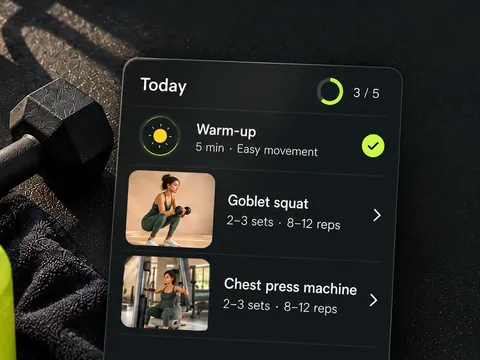 Getting started · 4 min readGetting the most out of StrideSet up your week, train with the app, and see what Jeevrit+ adds.Read article
 Training habits · 3 min readA routine you can keepChoose your days. Plan your session. Start where you are.Read article
 Exercise guide · 3 min readFree weights, made simpleA straightforward place to begin with dumbbells.Read article