
Training habits
How to build a consistent workout routine you can keep
Pick days you can protect, plan each session ahead, start lighter than you think and log what you do: a simple system for training consistently.

Most training plans fail for ordinary reasons. The plan asked for more days than life had to give, the sessions ran too long, or one missed week quietly became a missed month. Consistency beats intensity, especially in the first few months.
Start with the days you actually have
The World Health Organization recommends strength training on two or more days a week for adults, alongside regular activity that gets you breathing harder, like brisk walking or cycling. Two well-kept sessions a week is a real routine. Look at your week honestly, pick the days you can protect, and add a third only once two feel automatic.
Decide where you will train
Home and gym both work. A home routine needs little: a pair of dumbbells, a mat and perhaps a resistance band. A gym gives you machines and heavier loads. Choose the place you can still get to on your busiest day, because that is the day your routine is tested.
Make every session obvious
Deciding what to do when you arrive is where many sessions end before they start. Plan the session in advance instead: which exercises, how many sets, and roughly what weight.
- Lay out your kit the night before.
- Train at the same time on your training days.
- Keep a short, fixed list of exercises for the first few weeks.
Keep sessions short enough to finish
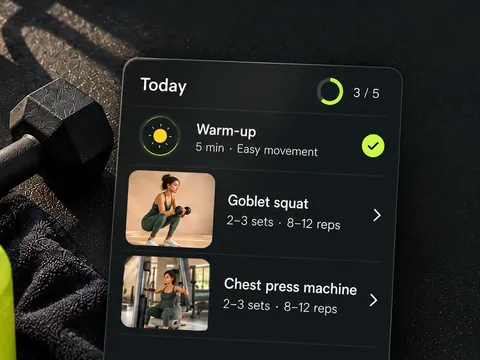
A focused 25 to 45 minutes is plenty. Five minutes of easy movement to warm up, then four to six exercises that cover the basics: a squat, a hip bend (like picking something up from the floor), a push, a pull and something for your core. Finishing a short session builds more momentum than abandoning a long one.
Start lighter than you think
Your first weeks are for learning the movements. Choose weights you could lift two or three more times at the end of each set. When every set feels under control, even at your highest number of reps, add a rep or a little weight. Our beginner’s guide to free weights explains how.
Log what you did, not what you planned
Record the sets, reps and weight you actually used. Next time, the last session becomes your starting point, and you can see progress that is too gradual to feel from one week to the next.
Plan for missed sessions
A missed session is not a failure. Two in a row is where routines start to slip. A simple rule helps: if you miss a day, do a short version on your next free day rather than waiting for next week. Rest days belong in the plan too, because your body adapts between sessions.
Review every four weeks
Once a month, look back. How many sessions did you complete? Which days worked and which kept getting moved? Are your weights creeping up? Adjust the days, the length or the exercises, and keep going.
Sources
This article shares general exercise information. If you have a health condition, an injury, are pregnant or are unsure whether an exercise suits you, check with a doctor or qualified trainer first. Stop if a movement causes sharp pain.
All Stride articlesFind your stride.
Plan your week, follow your session and log your sets. Stride lives inside the Jeevrit app.
Start trainingFree on Google Play for Android.More from the Stride journal
 Getting started · 4 min readGetting the most out of StrideSet up your week, train with the app, and see what Jeevrit+ adds.Read article
 Exercise guide · 3 min readFree weights, made simpleA straightforward place to begin with dumbbells.Read article
 Recovery · 4 min readTraining with more contextSleep, optional cycle context and the choice to take a lighter day.Read article